The Be of the Bang
As a lifelong athletics fun – and keen runner – I was fortunate to grow up in a golden era for Great Britain on the track. I was a little too young to appreciate the enthralling middle distance rivalry of Seb Coe and Steve Ovett and the trail they blazed for the young Steve Cram to follow, but my imagination was nonetheless captured by the athletic brilliance- and entertaining personalities – of the likes of Kriss Akabusi, Sally Gunnell, Roger Black, and triple jump world record holder Jonathan Edwards, amongst many others.
For the casual athletics fan – and even those who perhaps only dipped in to track and field once every four years in the Olympics cycle- the likes of Akabusi et al were very much household names. However, it was a less well known – and less decorated – athlete that truly inspired me as a youngster, and whose example left a more lasting impression: Derek Redmond.
Redmond was one of the world’s top 400m runners going into the 1992 Olympic Games. He should have run at the ‘88 games in Seoul, but cruelly, just 10 minutes before competing in the first heats, his Achilles tendon snapped, resulting in two years of painful surgery. Yet it was his dream to win an Olympic medal, and he had the performance to do it, going into the Barcelona games in the form of his life.
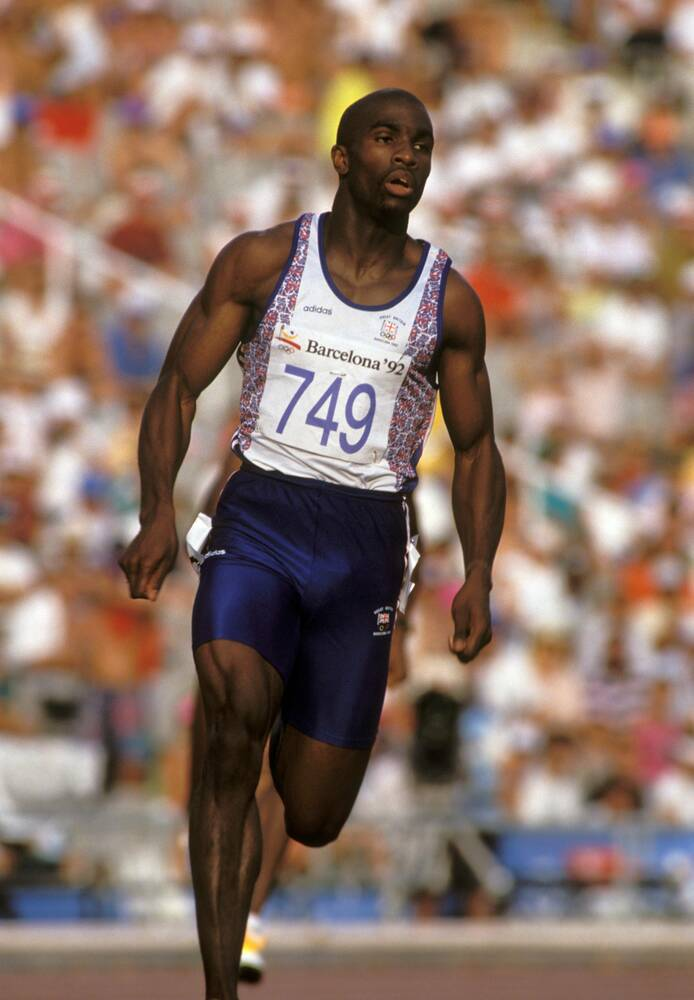
Progressing easily through the heats, everything was going to plan, and as he settled into his blocks for his semi-final, he focused on the goal of reaching that final – and the prospect of an Olympic medal- ensuring he kept focused and trusted in the training of the previous months and years.
With the crack of the starter’s pistol, Redmond was off like a shot and, settling in comfortably to his stride, made easy work of the first 200m. He was coasting, and looked set for an easy victory.
Then, with just 200m to go…BANG!
Redmond crashed to the track, grasping his leg. He thought he’d been shot.
He hadn’t; his hamstrung had snapped.
His dreams were over. Shattered.
Yet, with the other runners already having crossed the line, he picked himself up, and limped forward in his lane in quite evident agony. As he slowly dragged himself around the final bend, his father Jim- who had travelled especially to see his son compete- jumped over the barriers and onto the track, pushing the security away, and rushed to be with his son. The two men embraced, and the younger of the two Redmonds wept in his father’s arms, his dreams evaporated.
But together they walked all the way down that home straight. Why? Because Redmond was determined to get to that finish line.
And finish that race he did. To this day, it is the slowest ever recorded time of an Olympic 400m, but for me it remains an astonishing demonstration of the indomitable human spirit. It was Redmond, not the other runners, who received a standing ovation from the whole crowd. 70,000 athletics fans, on their feet, applauding a man who more than any other in that Games, seemed to embody the Olympic ideal.
Carry on going, he seemed to be saying to himself. Don’t give up. Persevere.
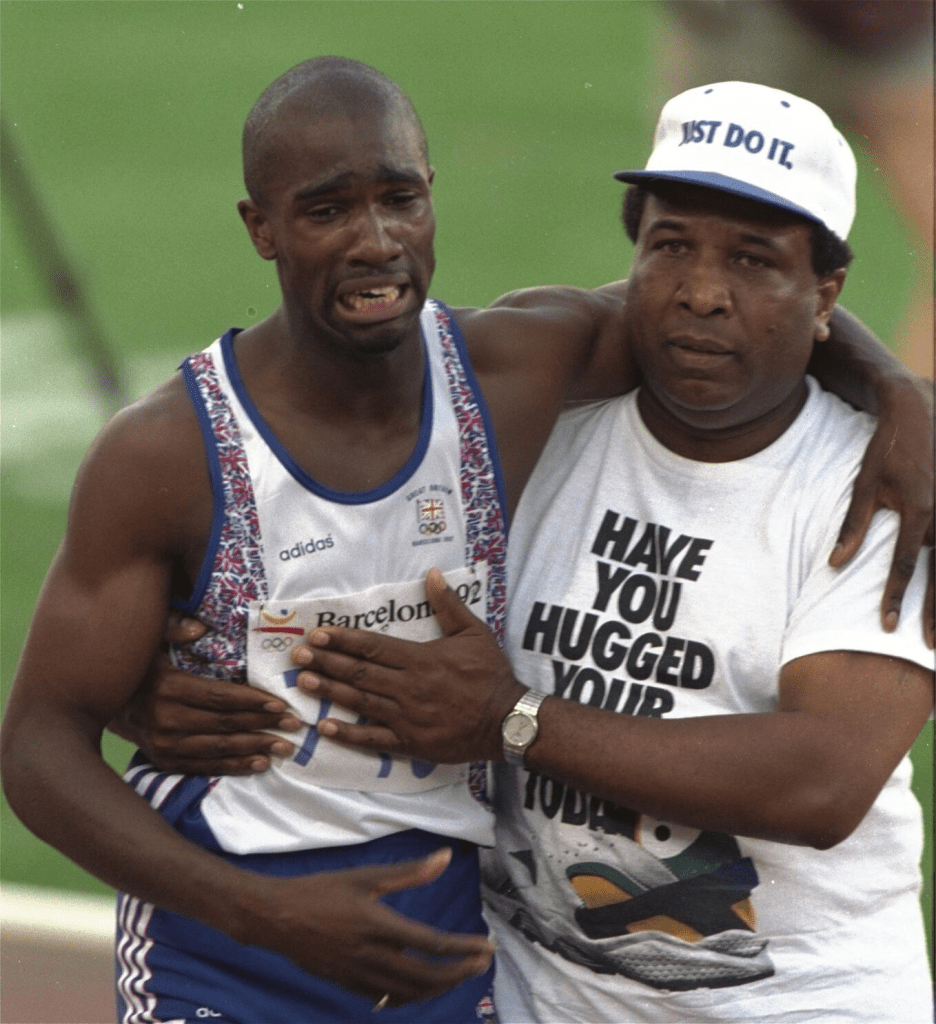
(Image: AP 1992)
Just Be It
The image of Derek Redmond and his father Jim walking those slow, limping steps towards the finish line is perhaps one of the most iconic sporting moments of all time, made all the more memorable given the cap Jim was wearing with Nike’s famous slogan. The Nike executives must have been rubbing their hands in glee at this free advertising and the poignant, powerful embodiment of determination, resilience and perseverance encapsulated in the Just Do It imperative lived out by Redmond in that race.
Athletics – as with most sports – is very much about the ‘doing’. Getting the job done in training; putting in the hard yards; getting out there when it’s cold and dark; doing what needs to be done. It’s goal-orientated, and all about competitive results. In this sense, Nike’s slogan is a good one. It’s very much about Just Doing It.
But Barcelona ’92 demonstrated powerfully that sport – as with life – is less about the ‘doing’ and more about the ‘being’. Redmond could quite easily – and understandably – have waited for the medics to scoop him off the track, and ended it there and then. He’d have avoided the agony of that final limp down towards the finish line, and the glare of the television cameras as his shattered dreams were played out live to the watching world. But this wasn’t about sport- or winning- anymore. It was about his very being- who he was, not as an athlete, but who he was as a person.
For Redmond, the finishing was important. His athletics talent – his ability to ‘do’ – became irrelevant in those final 200m; it was his attitude and approach – his ability to ‘be’ -that enabled him to complete that race. Courageousness; determination; perseverance. The ‘be’ of the Bang.
To Do or Not to Do
January is very much a month of ‘doing’. After the blur of the Christmas period, we tend to get down to the busyness of getting our affairs in order, looking towards the year ahead, and no doubt proclaiming a fair few New Year’s Resolutions.
As we head towards the end of January, I wonder how many New Year’s Resolutions have already fallen by the wayside, swallowed up by competing priorities and perhaps less achievable – or important – than we had first felt.

(Image: Shutterstock)
All too often, these resolutions resemble a 12 month ‘to do’ list: things we plan to achieve; things we’re going to do better; things we’re going to take up; or even things we’re going to stop. It’s very much about doing (or not doing), and in many senses that isn’t a bad thing. Whether it’s learning a new language, cutting down our carbon footprint, or reading more, these resolutions are specific, measurable, and provide a degree of accountability, at least if we’ve gone public with our New Year’s Resolutions.
Just do it, we tell ourselves.
But wouldn’t it be more impactful if our New Year’s Resolutions were less about doing, and more about being? Rather than setting ourselves goals, and targets, and aims we wanted to achieve, far better, surely, to think about what we can be, rather than what we can do.
Be more thoughtful. Be more considerate. Be more selfless.
I wonder whether we might even shift the way we carve up our daily tasks, focusing on a ‘To Be’ list rather than a ‘To Do’ list. As someone who needs a ‘to do list’ to keep on top of all the many spinning plates, I’d find it hard to completely drop a ‘to do’ list. But there’s no reason why a ‘To Be’ list can’t work alongside a ‘To Do’ list. I’m going to give it a go. Be first; do second. Why not join me?!
The Beauty of Being
Last weekend I witnessed a joyous, beautiful moment following the end of a competitive volleyball fixture against a local independent school – Wrekin College- where the two teams decided to stay on court after the match finished, but instead of competing against each other, they decided to mix the teams together. With the fixture already over, they wanted to continue playing just for the fun of it, with handshakes of introduction soon leading to high fives and fist pumps. This was about being, not doing.
As someone who has run competitively for the past 20 years, I’m certainly someone driven by a competitive instinct, but I’ve also always felt that sport is about so much more than winning, particularly at a school level.
Sport is, above all, fun. It’s about making friends. It’s about connecting with people, no matter if you’ve just met them and no matter where they’re from (in this instance, there were at least five nationalities represented on court). It’s about enjoying the moment, and being in the moment.
As a Head, the scoreline in that match (or in any match) doesn’t really matter to me. Seeing the way these youngsters joined together, encouraged each other, included everyone, and had fun together… that’s what matters to me, and that, to me, is what sport is all about.
It’s not about the doing. It’s about the being.
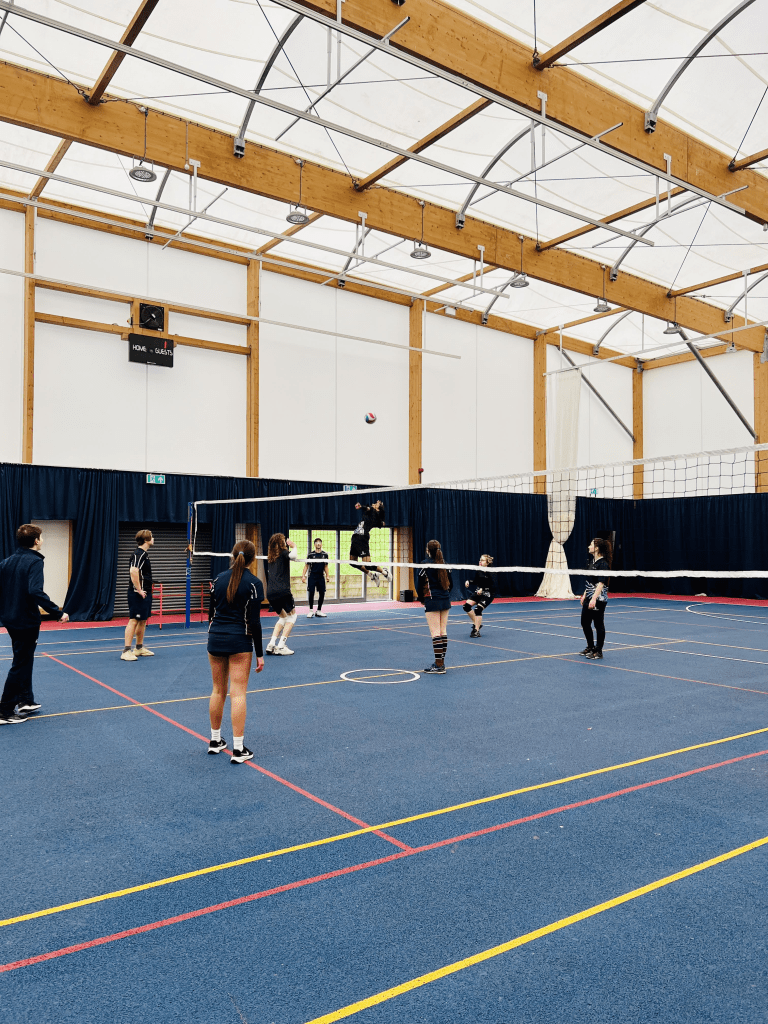
(Image: pupils from Oswestry School and Wrekin College enjoy a friendly game of mixed volleyball in the Momentum Hall, Oswestry)
Redmond inspired me as a youngster, and his example continues to inspire me to this day. He reminds me that life isn’t about winning, or achieving, or what we have done. People won’t remember us for the things that we’ve done; they’ll remember us, at the end of it all, for who we were. For our attitude, for our approach, for our impact on others.
So in 2024, let’s focus on the being not the doing. Let’s do less, and be more.
 Peter Middleton